
This is our 2nd guest blog from Josh, a 19-year-old Commercial Music student. With a passion for how social media, AI, and technology are reshaping the music industry, Josh offers fresh insights into their impact on today’s creative artists.
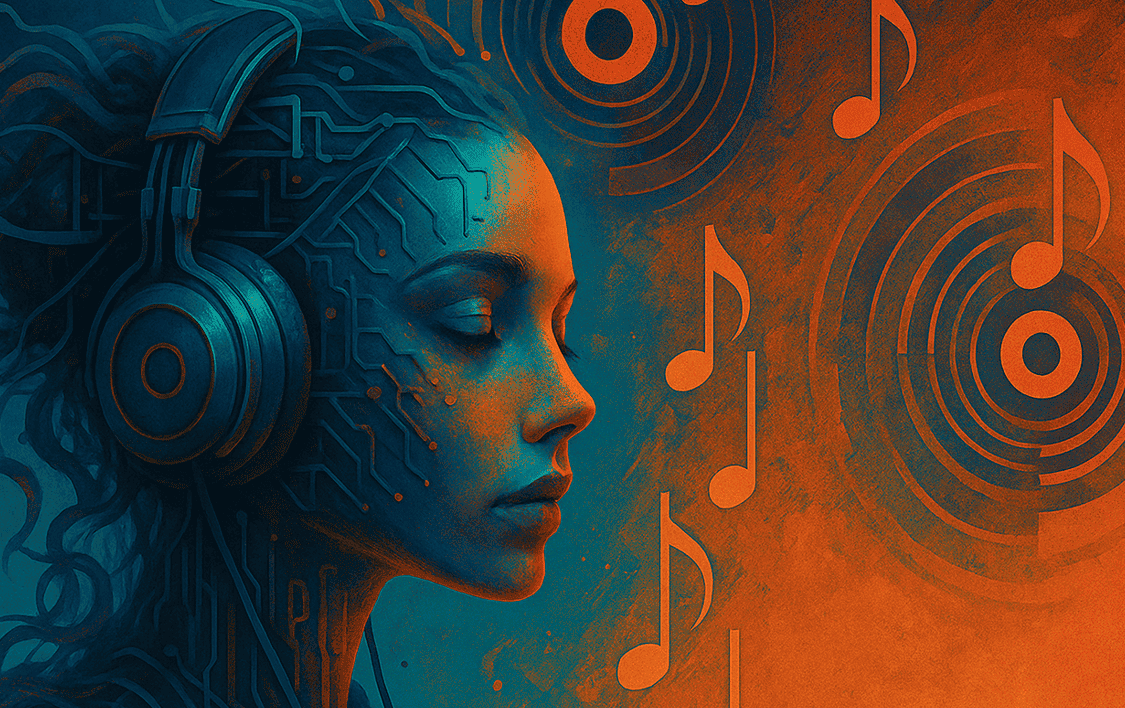
As technology continues to evolve at an exponential pace, the intersection of creativity and artificial intelligence (AI) is becoming increasingly relevant, especially within the music industry. This ongoing shift is raising important questions around individuality, authenticity, and the future of artistic expression.
Is the use of AI in music inevitable? And if so, what does that mean for the artists, producers, and composers who make the music we love?
In this post, I want to explore the complex and evolving relationship between musicians and AI. By diving into case studies, historical parallels, and emerging tools, I hope to offer a balanced overview of how AI could either support or disrupt the ways we create and experience music.
Looking Back: When New Tech Meets Music
Before jumping into the present-day uses of AI, it’s important to reflect on past reactions to groundbreaking tech within music.
When digital sampling entered the scene in the 1980s, it came with a wave of skepticism and controversy. Concerns about copyright, cultural appropriation, and fair use were front and center. Critics worried that reusing and manipulating existing materials would undermine originality. Yet today, sampling is not only accepted but celebrated as a skill, an essential part of modern music.
A similar story unfolded in the late 2000s with Auto-Tune. When Kanye West used it heavily on his fourth album, 808s & Heartbreak, the backlash was intense. The tool was misunderstood and criticized as a gimmick or shortcut. As Diaz (2009) put it:
“The entertainment value may be found in the instant gratification of a desirable sound without the time and exertion that comes with voice training and practice.”
Even major artists voiced their concerns. JAY-Z, for instance, responded directly with his now-iconic lyrics:
“This is anti-auto-tune, death of the ringtone,
this ain’t for iTunes, this ain’t for sing-alongs…
I know we facing a recession,
but the music y’all making going to make it the Great Depression.”
— JAY-Z (2009), D.O.A. (Death Of Auto-Tune)
Despite the resistance, 808s & Heartbreak is now recognized as a pioneering work, both “wildly popular and misunderstood in the moment” (Whitt, 2018). It paved the way for a more melodic, emotionally vulnerable style of hip-hop that artists like Travis Scott and Lil Uzi Vert have since built upon. What was once dismissed as artificial is now a creative focal point in entire subgenres. The pattern is familiar: technology enters, sparks resistance, then gradually becomes integrated.
AI Is Already Here
Today, AI is already integrated into multiple areas of the music industry. From composition to mixing and mastering, AI is now a powerful, efficient tool available to virtually anyone, no formal training required.
One of the most prominent platforms leading this shift is Suno. You might have heard of it. Suno allows users to generate entire tracks from a single prompt. You can give it guidance on genre, instrumentation, melody, and even lyrics. From there, the AI does the rest.
As (M, 2025) describes:
“Suno AI, a leading AI model in music generation, harnesses deep learning to mimic human creativity, producing compositions that are both stylistically diverse and sonically rich.”
It’s not just good, it’s often indistinguishable from music made by humans. (Pater, 2025) explains:
“It seems capable of generating music that is indistinguishable from non-AI music, at least in some genres, and when used correctly.”
But these developments have sparked concerns. Many artists are now working to protect their work from being used without consent to train AI models.
For example, in February 2025, over 1,000 UK musicians released an album titled Is This What We Want?, twelve tracks of studio silence, with each track name spelling out:
“The British Government Must Not Legalise Music Theft To Benefit AI Companies.”
Milmo (2025) explains it was a:
“protest against UK government plans to let artificial intelligence companies use copyright-protected work without permission.”
These concerns strike at the heart of artistic ownership. With tools like Suno and Udio becoming more sophisticated, there’s a real fear that AI could take over key roles in creative industries; writing, composing, producing, without involving or crediting human creators.
AI isn’t only transforming how music is made. It’s also changing how we listen to it. Spotify now offers an AI DJ that curates playlists based on your listening history:
“It will sort through the latest music and look back at some of your old favorites—maybe even resurfacing that song you haven’t listened to for years.” (Spotify, 2023)
In short: AI isn’t coming. It’s already here, and it’s not just a novelty. It’s becoming the new normal.
Can AI Really Feel?
This brings up a deeper, more emotional question: can we truly connect with music made by AI?
Music is often an emotional outlet. It reflects pain, joy, heartbreak, life. When we listen to our favorite songs, we find comfort in the fact that someone else has felt what we’re feeling.
“Music was the incarnation of the innermost reality, the immediate expression of universal feelings and impulses.”
– Grout and Palisca (2001, p. 543)
But can AI replicate that?
The article Artificial Intelligence and Musicking explores this dilemma. It argues that while AI can simulate music, it lacks lived experience. There are no memories, no emotions, no personal journey. Berkowitz (2024) shares:
“I think that music almost needs to kind of connect with the people or where people come from, and you can feel that when you play a tune… You could tell that they were written by a machine. There was just some lack of connectivity, or I couldn’t feel what the composer felt when they wrote the tune.”
Even if an AI track sounds polished, does it mean anything? Or is it just a mirror reflecting human patterns back at us?
For now, there still seems to be a gap, a noticeable difference between appreciating the sound and actually feeling the music.
Finding a Middle Ground
That said, AI doesn’t have to be the villain in this story. When used ethically and creatively, it can be an incredible asset.
Take Eminem’s 2024 album The Death of Slim Shady. He used AI voice filters to replicate his iconic early-2000s voice, a tone he can no longer naturally produce. The writing and performance were still his. The AI was simply a tool to help realize a creative vision.
To me, this is a brilliant example of human-AI collaboration. It’s not about replacing creativity, it’s about enhancing it.
AI is also helping people who might not otherwise have access to creative tools. Whether it’s ChatGPT for lyric writing or Midjourney for album art, it’s making creative expression more accessible.
As (O’Toole, 2024) notes:
“One potential benefit of AI tools is to support people in engaging in meaningful creative practices by improving accessibility to the creative process through providing functionality that lowers the barrier to entry.”
AI isn’t just a production engine. It can be a stepping stone, one that helps people explore, experiment, and learn.
Final Thoughts: Inevitable, But Not Uncontrollable
Whether we welcome it or not, AI’s presence in the music industry is already well underway, and accelerating. By looking at how we’ve adapted to past technologies, it’s clear that resistance often gives way to integration.
But this doesn’t mean we should give up control. We need to ensure AI is used ethically and transparently to support human creativity, not erase it.
Personally, I’ve used AI to help check the grammar and structure of this very post. But the thoughts, the voice, and the perspective? Those are mine.
So maybe the real question isn’t whether AI is inevitable. It’s how we choose to use it, as artists, as audiences, and as stewards of creative culture.
“Artificial intelligence should serve as a creative companion—supporting imagination, not substituting it. The true potential of AI lies in its ability to enhance human expression, not override it.” – ChatGPT, 2025